Showing posts with label WG series. Show all posts

Saturday, November 20, 2021

WG4: The Forgotten Temple of Tharizdun

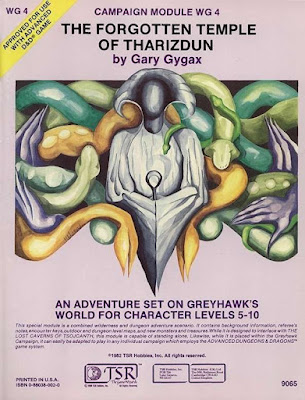
WG4 "The Forgotten Temple of Tharizdun" serves as a companion to module S4 "The Lost Caverns of Tsojcanth", expanding the wilderness map into another part of the Southern Yatils, southwest of the Gnome Vale.


Cover to module WG4 "The Forgotten Temple of Tharizdun" (1982) by Gary Gygax.  Illustration by Karen Nelson.*

*Nelson also contributed the back cover and interior illustrations.  Her family's relationship with Gygax was discussed by Frank Mentzer on Dragonsfoot:

A local family named Shook were friends of the Gygaxes. The kid, Eric, was badgered into working at TSR for a while, and was tacked onto my RPGA office in '81 or so for a brief time. His mother wheedled Gary into commissioning her for artworks, and hence the oddball watercolor cover for this piece. (Might have done the odd map, too.)

Frank Mentzer, posted on Dragonsfoot (April 27, 2005)


The Forgotten Temple:
The Temple was built in a previous age, a secret place of worship to Tharizdun, He of Eternal Darkness.  It drew the most wicked persons to it, and the cult flourished for generations, sending out its minions from time to time to enact some horrible deed upon the lands around.  However, a great battle eventually took place between Tharizdun and those opposed to his evil.  Unable to destroy him, they were strong enough to overcome his power and imprison him somewhere, by means none have ever been able to discover.  Thus Tharizdun disappeared from the face of the earth, and from all of the other known planes, and has not been seen again since.

from "The Forgotten Temple of Tharizdun" (1982)


The PCs are asked by the gnomes to track a band of marauding humanoids to their lair, which turns out to be an ancient, two-stepped, black ziggurat.

The temple consists of an upper and lower level, a dungeon level, and a hidden undertemple (which is difficult to locate, and may go undiscovered).


Tharizdun:

Gygax thanks Rob Kuntz "for inspiration regarding the subject material of this scenario."  Kuntz had earlier created the dark god "Tharzduun", who served as inspiration for Gygax's Tharizdun.*

*see "The Dark God: Historical Content, Developer Commentary, and an Ode to the Dark God" by Robert J. Kuntz (El Raja Key's Magical Emporium #4, 2003), republished in "Dark Druids" by Robert J. Kuntz (2006, 2015)

Kuntz states that Tharzduun was "conceived from CAS’s Thaisidon"* in this essay (originally published in AFS ("Anti-Fascist Society") zine #2.

*Thasaidon featured in the short story "The Dark Eidolon" by Clark Ashton Smith, (originally published in Weird Tales in January, 1935; available to read online, here)
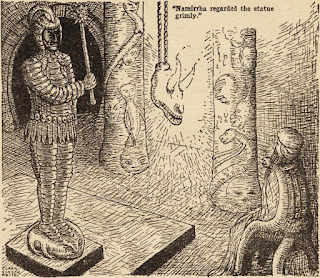

Illustration by Clark Ashton Smith for "The Dark Eidolon", originally published in Weird Tales (January, 1935).


Gygax envisioned a connection between Tsojcanth and Tharizdun, and incorporated Tharizdun into his "Gord the Rogue" novels.*

*see also "22 Questions on Tharizdun answered by Gary Gygax" posted on neuronphaser (June 9, 2016)


New Monsters:

WG4 "The Forgotten Temple of Tharizdun" uses monsters from the Fiend Folio (1981):

Aarakocra (Bird-Man), Caryatid Column, Coffer Corpse, Giant (Mountain Giant), Grell, Guardian Daemon, Meazel, Norker, Shadow Demon, Stunjelly

In addition, two new monsters were described:

Annis, Boggart


The WG1-4 Campaign:

If you are actually utilizing this module as an adjunct to "The Lost Caverns of Tsojcanth", you might consider what was done in the actual campaign from which both were written.  The adventurers discovered Gnome Vale in the course of seeking the 'Caverns.  Later, they returned for rest and recuperation after suffering severe damage exploring the latter place.  Only three or four of the original party actually journeyed to the 'Temple, because, as is usual with any group, some of its number were not on hand when it was time to adventure.  Because only a portion of the group went, the gnomes went along.  After initial contact and a couple of pitched battles, several of the other party members joined the three, and the 'Temple was sacked.  Losses were minimal, because the players were reasonably adept, and hit-and-run tactics were used.

Gary Gygax, from "The Forgotten Temple of Tharizdun" (1982)


Gygax ran his group through an early version of "The Village of Hommlet" back in late 1975/early 1976, and again 2-3 years later, likely as a playtest for the module.

They later adventured in a revised/expanded version of the Lost Caverns of Tsojcanth, followed by the Forgotten Temple of Tharizdun.

Gygax acknowledges the original set of players (Luke Gygax, Mike Olson, Sonny Savage, Richard Kuntz, and Mitch Preston) in WG4.*

*playtesters listed in the credits include Jeff Dolphin, Luke Gygax, David Kuntz, Richard Kuntz, Mike Olson, and Sonny Savage

See also "From Hommlet to Tharizdun, by way of Tsojcanth" posted on the Greyhawk Grognard blog (March 22, 2013).


Running WG4:

WG4 "The Forgotten Temple of Tharizdun" is designed for up to 12 characters, levels 5-10 (although ideally 4-8 characters, levels 8-10).  By comparison, S4 is for 6-8 characters, levels 6-10).

For a Master Class in running WG4, review the "Cold Text Files" (parts 1-9) accessible through the Wayback Machine, here (strange how online material regarding Tharizdun is often deleted...)

See also "Thoughts on The Forgotten Temple of Tharizdun" posted on the Greyhawk Grognard blog (April 12, 2018).
Saturday, November 13, 2021

S4: The Lost Caverns of Tsojcanth

S1 "Tomb of Horrors" and S3 "Expedition to the Barrier Peaks" were tournament scenarios (from Origins I and Origins II, respectively), precursors to the C (or "Competition") series, while S2 "White Plume Mountain" was a puzzle dungeon, submitted by Lawrence Schick.


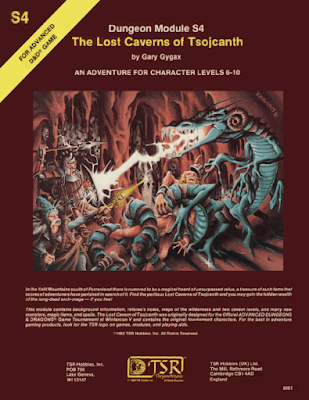
Cover to module S4 "The Lost Caverns of Tsojcanth" (1982) by Gary Gygax.  Illustration by Erol Otus.


S4 "The Lost Caverns of Tsojcanth" is similar to S1 and S3, having likewise originated as a tournament scenario (for Wintercon V in 1976), but was extensively reworked by Gary Gygax (who restocked the caverns and added a wilderness section).

The result is a heavily revised adventure, explicitly set within the recently published "World of Greyhawk" setting:

If the "World of Greyhawk" fantasy world setting is part of your campaign, the party is sponsored by the Margrave of the March of Bissel.  Perrenland, Ket, Veluna, and Iuz are enemies or rivals of Bissel.

Gary Gygax, from S4 "The Lost Caverns of Tsojcanth"


Gygax ran his Village of Hommlet group through "The Lost Caverns of Tsojcanth" (playtesters listed in the credits include Jeff Dolphin, Luke Gygax, David Kuntz, Richard Kuntz, Sonny Savage, and James M. Ward).

S4 (and its companion WG4 "The Forgotten Temple of Tharizdun") therefore serves as a fitting adjunct to T1-4 "The Temple of Elemental Evil" as part of a broader campaign set within the World of Greyhawk (perhaps concluding with the GDQ series).


The Wilderness:

Gygax states "Each hex is approximately 3.5 miles across. It shows the border areas of Ket and Perrenland, between the Velverdyva River and the town of Krestible, as shown on the map of the WORLD OF GREYHAWK Fantasy World Setting."


Approximate location of the wilderness map from S4 "The Lost Caverns of Tsojcanth" (1 hex = 3.5 miles, left) on the World of Greyhawk map (1 hex = 30 miles, right) based on terrain.


Unfortunately (and as discussed elsewhere) there is poor correspondence between the wilderness map* and World of Greyhawk map.  (See "The Southern Yatils" by Denis Tetreault for ways to address this).

*a standard scale of 8 miles/hex works much better


The Caverns:

The lesser and greater caverns represent a challenge for experienced players.  The high density of deadly creatures is problematic for some, but I like to consider this a reflection of the caverns as a nexus between worlds, so that its inhabitants constantly change.

*grodog's "The Lost Caverns of Tsojcanth" page is an excellent resource for anyone running the adventure


Booklet 2:

In addition to the 32-page scenario booklet, module S4 "The Lost Caverns of Tsojcanth" came with a 32-page supplementary booklet detailing new monsters and magical items:

New Monsters

Bat (Normal, Mobat), Behir, Bodak, Cave Cricket (Giant), Cave Moray, Cooshee,* Crystal Ooze, Dao,* Demi-Lich, Demon (Alu-Demon, Baphomet, Bar-Igura, Chasme, Dretch, Fraz-Urb-Iuu, Graz'zt, Kostchtchle, Rutterkin), Derro, Dracolisk, Elf (Valley),* Formorian, Gorgimera, Marid,* Marlgoyle, Olive Slime, Pech, Pudding (Deadly), Troll (Marine), Slime Creature, Wolfwere, Xag-Ya, Xeg-Yi

*the Dao and Marid were featured in Dragon #66 (Oct 1982), and the Valley Elf and Cooshee in Dragon #67 (Nov 1982), shortly after module S4 was released, perhaps as a form of cross-promotion

Magical Items

Potions (Rainbow Hues, Vitality)
Miscellaneous Magic (Dagger +2/Longtooth, Horn of Fog, Lens of Detection, Prison of Zagig, Slippers of Spider Climbing)

Artifacts

Daoud's Wondrous Lanthorn


The Demonomicon of Iggwilv, illustration by Jeff Easley (with hidden messages in the script)


Demonomicon of Iggwilv:

Clerical Spells

4th Level (Abjure)
7th Level (Exaction, Henley's Digit of Disruption)

Magic-User Spells

5th Level (Dismissal, Dolor)
6th Level (Ensnarement)
7th Level (Banishment, Torment)
8th Level (Binding

Prison of Zagig


Magical Diagrams*

*appeared in earlier form as "Protection circles and the like, plus news of the north central Flanaess" in Dragon #56 (Dec 1981) in which module S4 is mentioned to be in development


Reputed Properties of Gems


Sequels and Derivative Works:

S4 "The Lost Caverns of Tsojcanth" was included in the supermodule S1-4 "Realms of Horror", with some modifications.

The loosely connected module S5 "The Dancing Hut of Baba Yaga" for 2e, by Lisa Smedman, contains additional information on Iggwilv.

The adventure was updated to 3.5e in "Iggwilv's Legacy: The Lost Caverns of Tsojcanth" (Dungeon #151, Oct 2007) by Edward Albert, Ari Marmell, and C.A. Suleiman.*

*downloadable here

See also Jason B. Thompson's walkthrough map.

Saturday, September 18, 2021

T1: The Village of Hommlet

T1 "The Village of Hommlet" by Gary Gygax was TSR's tenth "Dungeon Module" (not counting the special collector's edition of "Lost Tamoachan"), and was originally made available for sale at Gen Con XII in August, 1979, (along with S2 "White Plume Mountain").


Full-page advertisement for module T1 "The Village of Hommlet" appearing in The Dragon #s 31-32 (November-December, 1979)


Like module B1 "In Search of the Unknown" and S2 "White Plume Mountain", T1 "The Village of Hommlet" wasn't based on a previous tournament adventure.  Bob Byrne recounts its gaming origins in a post on Black Gate, in 2017:
 
Gygax’ son and a friend were starting to play, so Gary used the Hommlet campaign as a new, low level adventure for them, distinguishing it from the high level Greyhawk play. Gygax was busy developing TSR products and the Greyhawk Supplement (I) had come out for the Original Rules.
The Hommlet campaign was different than the Greyhawk dungeon delves. There was a village, with a smithy, an inn, a local elder, set in a rural environment. The party could role play in the village then move on to the dungeons of the Temple. It’s possible that Gygax ran players through some iterations of Hommlet and the Temple in late 1975 and into 1976.
from Black Gate* (January 6, 2017)


*Byrne's article provides a comprehensive overview of the original Temple of Elemental Evil campaign, and is well worth a read.  (There are also links to several other articles on Black Gate regarding the Village of Hommlet and Temple of Elemental Evil).

Gygax set aside his DMing responsibilities in 1976 in order to work on the AD&D rulebooks, in addition to penning the first seven dungeon modules (the G series, the D series, and S1), before turning to the ambitious World of Greyhawk folio.

Modules S1, B1, and S2 included references to the World of Greyhawk, which was originally planned for release in early 1979.  Gygax provided even more details in module T1, rendering it a perfect starting place for campaigns in the soon-to-be-published setting. 


Siege of Bodenburg:

The first Gen Con was held back in 1968, where Gygax played The Siege of Bodenburg, a medieval miniatures wargame.  He subsequently used Bodenburg Castle to represent the ruined upper works of Greyhawk Castle, as well as the floorplan of the moathouse in module T1.


Schematic for Bodenburg Castle (left) and the map for the ruined moathouse from module T1 "The Village of Hommlet" (right).

The destruction of the moathouse as recounted in "The Village of Hommlet" was apparently based on the Siege of Bodenburg, and has been recreated as a Chainmail scenario "The Battle for the Moathouse" by Paul Stormberg.


The Temple of Elemental Evil:

T1 was re-released in 1981 as a color version, with new front and back cover art, although the promised T2 "The Temple of Elemental Evil" wasn't forthcoming.

After finishing T1, Gygax was approached by Brian Blume to write a replacement module for the Holmes Basic Set, which became B2 "The Keep on the Borderlands".  (Had Blume not done so, I wonder if Gygax would have instead written T2 "The Temple of Elemental Evil"?)

Without T2, I've posted elsewhere that B2 works well as a sequel to T1.  One could even continue with WG4 "The Forgotten Temple of Tharizdun" as a Gygaxian trilogy of sorts.


The Moathouse:

The cover to D&D accessory AC5 "Player Character Record Sheets" (1984) features an illustration by Clyde Caldwell depicting a group of adventurers approaching the ruined moathouse from T1 "The Village of Hommlet".


Painting by Clyde Caldwell depicting the ruined moathouse, used for the cover of AC5 "Player Character Record Sheets" (1984)


I corresponded with Caldwell back in 2010 about this illustration, at which time he kindly responded with some additional details:

The AC5 cover painting was actually the first cover I did after coming on staff at TSR.  It was done for another module called "The Moathouse".  The publication of "The Moathouse" was delayed for some reason and the cover painting was sidelined for a while.  I don't know if "The Moathouse" module was ever published, but I think not.  The painting was picked up for AC5 since it showed a variety of generic characters.  My title for the painting is still "The Moathouse".

Clyde Caldwell, 2010


According to this interview on the Random Wizard blog, Caldwell probably began working at TSR around July, 1983.  Given that it depicts a scene from T1, "The Moathouse" may have been intended for the cover of a renumbered module WG1.*

*in Dragon #71 (March, 1983) Gygax stated "Pending work which will eventually be done includes the Temple of Elemental Evil (formerly designated as module T2 but which will be released as WG 2, part 1 and 2)"


Sequels and Derivative Works:

Gygax's original manuscript for "The Temple of Elemental Evil" was ultimately completed by Frank Mentzer and published as T1-4 "The Temple of Elemental Evil" (1985), which I ran for my friends during our senior year in high school.

A novelization of the adventure "The Temple of Elemental Evil" by Thomas M. Reid was published in 2001, as part of the "Greyhawk Classics" series.

A sequel for 3e "Return to the Temple of Elemental Evil" by Monte Cook was released in 2001, set 15 years after the original adventure.

The Temple of Elemental Evil was also developed as a video game by Atari, in 2003.

Hackmaster published "The Temple of Existential Evil" by Brian Jelke in 2003.

"Return to the Moathouse" by Mike Mearls was released at the Origins Game Fair in 2008, and a 4e conversion of "The Village of Hommlet" by Andy Collins was published in 2009, and republished in Dungeon #212 (March, 2013).

Dragon #423 (May, 2013) included a "tavern profile" on the Inn of the Welcome Wench by Shawn Merwin, and Dragon #425 (July, 2013) featured articles on the history of "The Temple of Elemental Evil" by Skip Williams, and "The Anatomy of Elemental Evil" by Thomas M. Reid.

See also Jason B. Thompson's walkthrough map.

A "Dungeons & Dragons: Temple of Elemental Evil Board Game" was released by Wizards of the Coast in 2015.

Finally, a two-volume homage and 5e conversion was just released by Goodman Games as Original Adventures Reincarnated #6 (be sure to check out the recently posted unboxing video for a sneak peak at the contents).


The Deed of Paksenarrion:

It has been pointed out that "Divided Allegiance" (1988), the second book in "The Deed of Paksenarrion" by Elizabeth Moon contains many parallels to T1 "The Village of Hommlet" (as discussed in this post from The Mule Abides blog)

This Month's Most Popular Posts