Showing posts with label Greyhawk. Show all posts

Saturday, October 5, 2024

Arnecon 2

Arnecon 2 is being held this weekend, honoring the creative genius of Dave Arneson, co-creator of Dungeons & Dragons, and his game group, The Blackmoor Bunch.


Arnecon 2, October 4-6, 2024


I arrived in Minneapolis yesterday afternoon, and immediately bumped into special guest Rob Kuntz, who made the trek all the way from Corsica.  It was nice to finally meet Rob in person, and amazing to reflcct upon his contributions to the hobby.


Blackmoor:


DA5 City of Blackmoor (never published)

The weekend got off to a great start last night with Paul Stormberg hosting a party of 15 players as our characters explored Blackmoor Castle and its dungeon.  (My character succumbed to the fatal bite of a lamia in the confusion of the final encounter).

The adventure was based on Dave Arneson's manuscript for DA5 "City of Blackmoor".  In speaking with Paul afterwards, it would appear that it was a copy of this manuscript that was discovered by DA series collaborator Dave Ritchie's half-brother.


The Slave Raiders:


Terrance's Free Company.  Illustration by Walter Moore


This morning, I'll be running "The Slave Raiders", the first part of a Blackmoor game scenario by Dave Arneson, written for D&D.  Originally published in "Different Worlds" #42 (May/June 1986) as "Garbage Pits of Despair: Part 1".

Pregens include Terrance of Walworth (F10),* Long Bill Jordan (F8), Joey the Hobbit (T9), Andy the Jack (F7), and Father Laum (C9).

*in speaking with Rob Kuntz, he believes this is a shout-out to his brother Terry Kuntz


Dave Arneson's Medieval Battle:

This afternoon, I'll be playing "what some consider to be the earliest incarnation of Blackmoor: Dave Arneson's Medieval Battle Notes for a war gamed RPG. Set in the Blackmoors" using an early edition of Chainmail from the Domesday book.


Greyhawk:

Another game hosted by Paul, run from a manuscript using an unpublished level of Greyhawk Castle.  I've never had a chance to play in one of these games run by Paul at Garycon, so this was a great opportunity.

Update (October 6, 2024): Our group had a phenomenal time with this one.  Paul is a fantastic DM and a great guy to boot.  Our PCs were successful in our objective, and learned some deep Gygaxian lore in the process.


The Dragon Hills:


Illustration by Walter Moore


On Sunday morning, I'll be running "The Dragon Hills", the second part of "Garbage Pits of Despair" by Dave Arneson, originally published in "Different Worlds" #43 (Jul/Aug 1986).


Into the Wild Blue Yonder:

I'll be wrapping up the weekend by participating in Rob Kuntz's new AD&D 1e adventure "Into the Wild Blue Yonder", set in Blackmoor, involving a quest into the Realm of the Dead to stop a war in the land of the living.

Saturday, March 19, 2022

X1: Derivative Works

X1 "The Isle of Dread" has been revisited multiple times in recent years, resulting in a wealth of new material for those running a campaign (including two poster-sized maps).


Torrents of Dread:


Cover to Dungeon #114 (September, 2004).  Illustration by Wayne Reynolds.


"Torrents of Dread" is a 3.5e adventure for mid-level characters (ideally, four 6th level characters), by Greg A. Vaughn, published in Dungeon #114 (September, 2004).

The adventure takes place in the village of Mora, one of the native villages on the southeastern peninsula, and is based on the "Destroy the Zombie Master" scenario, from suggestions for further adventures in the original module.

The island was transplanted to the Greyhawk setting, specifically the Densac Gulf, bordered by the Azure Sea to the north and the Pearl Sea to the south.


Poster map of the Isle of Dread, from Dungeon #114, also distributed at GenCon in 2004.  Cartography by Christopher Trevas.


Dungeon #114 also contains the article "Exploring the Isle of Dread" by Gary Holian, one of the co-authors of the Living Greyhawk Gazetteer.

The article includes an updated excerpt from Rory Barbarossa's ship's log, various legends, and a mini-gazetteer of the Isle of Dread, complete with updated wandering monster tables.


Savage Tide:


Cover to Dungeon #139 (October, 2006).  Illustration by Dan Scott, a homage to the original cover to module X1: The Isle of Dread.

The "Savage Tide" adventure path involved a series of 12 interconnected adventures, published from Dungeon #139 (October, 2006) to Dungeon #150 (September 2007).*

*a seven-page preview of all 12 parts of the Savage Tide adventure path was published in Dungeon #138 (September, 2006)

The PCs begin as 1st level characters, and can rise as high as 20th level by the campaign's conclusion.  (Parts 3-7 involve the Isle of Dread.)

Although set in the World of Greyhawk, see also Adapting the Savage Tide Adventure Path for Mystara, published in Threshold #4.


Poster-sized player's map of The Isle of Dread, from Dragon #351, a supplement to the article "Ecology of the Isle of Dread".


A series of supporting articles for the Savage Tide adventure path "Savage Tidings" were published from Dragon #348 (October, 2006) to Dragon #359 (September, 2007).

Dragon #351 also contained an article for players "Ecology of the Isle of Dread: The Journal of Larissa Vanderboren" by Jacob Frazier, together with a poster-sized player's map.


Attack of the Tyrantclaw:


Cover to "Attack of the Tyrantclaw" (2011) by Matt James and Greg Bilsland.  Illustration by McLean Kendree.


The D&D 4e Manual of the Planes (2008) situated the Isle of Dread within "the Feywild", the realm of faeries, from which the island "worldfalls" to other planes (pg 43-44).

"Attack of the Tyrantclaw" is set among the ruins of Tanaroa, and was designed for five 6th level characters, as part of the spring 2012 installment of the D&D 4e Lair Assault program.


Original Adventures Reincarnated #2:


Cover to OAR #2 "The Isle of Dread" (2018).  Illustration by Jeff Dee.


A repackaging of the original versions of module X1, with a new frontispiece by Erol Otus, introductory retrospectives, and a detailed conversion to 5e,* by Chris Doyle and Tim Wadzinski.

*the D&D 5e Dungeon Master's Guide (2014) relocated the Isle of Dread once again, this time, to the Plane of Water (pg 56-57)

In addition, there are 20 new encounter areas on the island, seven new encounter areas on the central plateau, and an expansion of the dungeons beneath the temple on Taboo Island.

There are also some additional suggestions for new adventures, incorporating new material, as well as information on Elemental Gates.


Additional works:

The Kopru Ruins (2006) by Darrin Drader.

The X1 "Isle of Dread" D&D Next Playtest (2012).

Jason B. Thompson's walkthrough map (2013).

The Y’ruvex Swamps (Dyson's Dodecahedron, Apr 4, 2019)

Saturday, November 27, 2021

Q1: Queen of the Demonweb Pits

Module Q1 "Queen of the Demonweb Pits" by David C. Sutherland was released in October, 1980.  The long-awaited conclusion to the G-series and D-series trilogies, it was also intended to be "The first of a new series of other-planar adventures".*

*see "Playing on the Other Planes of Existence" in The Dragon #32 (December, 1979) for plans regarding additional adventures on the Astral, Ethereal, and Elemental planes


Cover to module Q1 "Queen of the Demonweb Pits" (1980) by David C. Sutherland III with Gary Gygax.  Illustration by Jim Roslof.


Lolth, the Demon Queen of Spiders, is worshipped by the Drow, although was not the actual mastermind behind the attacks of the giants.  The adventure is therefore useful as a standalone, but lateral to the metaplot of the preceding modules.


Design Origins:

The development of module Q1 has a long and storied history.  About a year before its release, it was revealed that Gary Gygax would not be writing it:
Question: When will Q1, QUEEN OF THE DEMONWEB PITS, be released?  I am really looking forward to playing in it.

Answer: Q1 is being written by Dave Sutherland, TSR’s Art Director.  Dave has a lot of demands on his time and is working on it as often as he can.  We are very short-handed in the Art Dept. and I cannot say when Q1 will be ready for release.
From The Dragon #31 (November, 1979)


The following month, Gygax provided more details in his column "From the Sorcerer's Scroll":
...I also worked up a number of dungeon modules, including the series which will culminate in an adventure on one of the planes of the Abyss (Q1, QUEEN OF THE DEMONWEB PITS).
It so happened that Dave Sutherland had a splendid inspiration regarding this setting, so my rather sketchy notes were set aside for use in another module, and Dave was given the go-ahead to do the scenario.  (As of this writing, it is nearly complete, and I hope that it will soon find its way into print!)  The information in the module should be sufficient to serve as a guide for development of the entire 666 “layers” of the Abyss.
From The Dragon #32 (December, 1979)


When the adventure was finally published, Gygax explained the following in its Preface:
As this is the last of a series of seven modules, six of which were authored by me, you might well wonder why this one was done by Dave Sutherland.  The explanation is simple.  About two years ago I laid out the outline of the action for this whole series, and over the next six months wrote as many modules.  The last was the crowning piece, of course, and it was left aside until a considerable period of time could be spent addressing it so as to assure that DEMONWEB was, in fact, something special.  In the meantime, I had to get busy finishing the DUNGEON MASTERS GUIDE, already behind schedule because I'd spent time on module design.  As I was reviewing my ideas for DEMONWEB, it suddenly struck me that what I had sketched out was far too similar to another module "rough" I was committed to: the TEMPLE OF ELEMENTAL EVIL, the final part of the VILLAGE OF HOMMLET (AD&D module T1).  Now I was faced with a true dilemma.

Finishing a module from an outline is not a difficult task.  Creating a whole new setting is, and that was exactly what was required for one or the other of the modules I was committed to.  Then one day, as I was talking with Dave, the quandary was resolved.  He showed me an idea he had for a "dungeon" level, and what a level!  What an idea!  This, I told him, was the perfect setting for the DEMONWEB, and straightaway placed the entire project into his capable hands.  Since then, he has been hard at work developing and perfecting the scenario you now have before you.  My only contributions have been some brief notes, a monster, a bit of editing, and this introductory piece.  I am certain that you will find DEMONWEB to be a superior design, and Dave deserves all the credit.  It is a fitting climax of and culmination for the other adventures in the series.  DEMONWEB is remarkably innovative and imaginative.  Take a look now, and see if you don't agree that it is special indeed - guaranteed to give your players unsurpassed challenge.  This module is truly for the expert player, and ability - not character level - will be the telling factor.  Enjoy!
Gary Gygax, from "Queen of the Demonweb Pits" (March, 1980)


Years later, Gygax revealed that he had little actual say in the decision:
As for Q1, Ask Dave Sutherland and Brian Blume about that.  It was taken out of my hands by the latter when Sutherland discovered the "Demonweb" pattern in a hand towel and talked Brian into using it as the main theme for the concluding module.  I had no creative control over it.

I had hoped to get to the Elder Elemental god in a sequal to the ToEE, but...
Gary Gygax, from EN World (February 24, 2003)


When asked about his original intent for "Queen of the Demonweb Pits", he stated:
My concept was that Eclavdra was aiming at dominance of the Drow through using the EEG to replace Lolth.  she, as the chief priestess of the elemental deity would then be the mistress of all.  The final scenario was to have been one in which the adventurers got involved in the battle between the evil entities and made it so that both lost and were tossed back to their own planes, relatively powerless in the Mundane world for some time to come.
Gary Gygax, from EN World (February 24, 2003)


These comments were reiterated on EN World in August, 2006, (here, here, and here) and have inspired some to develop their own conclusion to the GDQ series, using a plot more in keeping with what Gygax had originally envisioned.


Credits:

Sutherland was aided in the development of the adventure by David Cook and Tim Jones (whose contributions, particularly Cook's, may have been substantial).  Frank Mentzer did the editing and layout.  (According to Mentzer, the Demonweb was inspired by the design on a placemat, citing Sutherland himself).

Q1 also credits a list of individuals for their "able assistance", including Allen Hammack, Kevin Hendrix, Harold Johnson, Brian Pitzer, Paul Reiche III, Evan Robinson, Lawrence Schick, and Tom Wham.

Playtesters included Mark S. Anderson, David Cook, Helen Cook, Peter Drzewiecki, Lorece Ferm, Bill Hoyer, Kevin Huigens, Harold Johnson, Jon Jones, Dave LaForce, Alan Lepkowski, Mack Mackenzie, Frank Mentzer, Erol Otus, Brian Price, Don St. Ouge, Lawrence Schick, James Tessmer, Susan Tessmer, and Bob Waldbauer.


Spell Alterations:

Since the Demonweb is one of the 666 layers of the Abyss, spell casting works differently than on the Prime Material Plane.  While it's possible to learn how to cast spells correctly, the PCs will be unaware of this, and so a list of spell alterations is given.

Rules are provided for clerical, druidical, magic-user, and illusionist spells.  (A list of alterations for the spell effects of magical items is also given.)


The Demonweb:

The Demonweb has a convoluted, M.C. Escher-like quality, comprised of three interwoven levels, above which floats a separate, fourth level:


High-resolution map of the Demonweb, available for download, here


Each of the first three levels contain four doorways leading to other levels of the Abyss.  The fourth level contains eight gateways leading to alternate worlds, and a final doorway leading to Lolth's palace, on yet another layer of the Abyss.*

*the adventure therefore involves 14 different layers of the Abyss, and includes suggestions for adding three to four doorways to each of the first three layers, increasing to 24 different layers of the Abyss

As an adventure location, the Demonweb is wonderfully imaginative.  It can be restocked with new creatures, and plunked wholesale into any high-level campaign.*  (I feel that it has a B/X rather than AD&D aesthetic, possibly owing to Cook's involvement).

*alternatively, the three levels can be used as the template for a basic-level or expert-level dungeon, restocked with the appropriate creatures


Alternate Worlds:

The gateways leading to other or alternate worlds on the Prime Material Plane leverage the concept of a D&D multiverse:

The Kingdom of Caer Sidi
"An artificial twilight seems to hang over the land and the sun is apparently always behind a bank of clouds."*
*based on the realm of Faerie in Poul Anderson's "Three Hearts and Three Lions"
 
The Frozen Lands
The gateway leads into a cave within a frozen mountain range.
(I suggest using the animated film "Fire and Ice" (1983) for inspiration, here.
 
The Great Ocean
"The doorway is set on a white, sandy beach...  The sky is saffron yellow and the sun is a pale bright blue; a pink ocean...washes gently over the sand."
An alien world, home to underwater races and a human society reminiscent of Ursula K. Le Guin's "Earthsea" trilogy (ie. the Raft People in "The Farthest Shore").
 
The Black Fen
A vast, desolate swamp, "ringed by a wall of mountains."
 
The Labyrinth of Arachne
A subterranean maze, used as breeding ground for spiders.
 
Maldev
"the last kingdom of the mountain dwarves in this world"
The PCs arrive as a major battle is about to commence (it is suggested to determine the outcome using miniatures).
 
The Nightworld of Vlad Tolenkov
A land of perpetual night, ruled by a vampire lord, in a world with no sun. 
 
Lolth's Prison
A miniature, disc-shaped world, situated at the edge of the galaxy.

For those wishing to expand the module even further, six additional worlds are suggested:

Cloud World
Tundra
Jungle
Savanna
Airless World
Woodlands

While sketched out in varying degrees of detail, entire adventures can be placed in any of these additional worlds.  (Alternatively, the DM may use one or more as the basis for adventures in their home campaign).


The Spider Ship of Lolth:

Lolth's castle is actually a giant, steam-powered, spider-ship.  While in keeping with the otherworldly theme of the adventure, some regard it as discordant.  (For an alternative, see the free adventure "Skein Of The Death Mother" on Dragonsfoot).


New Monsters:

Drider, Pedipalp (Large/Schizomida, Huge/Amblypigi, Giant/Uropygi), Scorpion (Large, Huge), Solifugid (Large, Huge, Giant), Yochlol (Handmaiden of Lolth)

Statistics are also provided for Lolth herself, the Demon Queen of Spiders.


Sequels and Derivative Works:

The module was included in the supermodule GDQ1-7 "Queen of the Spiders" (1987).

The adventure was novelized by Paul Kidd in 2001

The Demonweb Pits were revisited in "Expedition to the Demonweb Pits" (2007) by Wolfgang Baur and Gwendolyn Kestrel, for 3.5e.

Update (February 9, 2022): see also Q2: Web of Souls, by Joseph Block, which aligns more with Gygax's original intent for the conclusion to the GDQ campaign arc, and may be substituted as a complete replacement for Q1

Saturday, November 20, 2021

WG4: The Forgotten Temple of Tharizdun

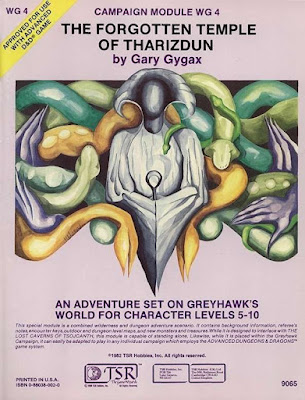
WG4 "The Forgotten Temple of Tharizdun" serves as a companion to module S4 "The Lost Caverns of Tsojcanth", expanding the wilderness map into another part of the Southern Yatils, southwest of the Gnome Vale.


Cover to module WG4 "The Forgotten Temple of Tharizdun" (1982) by Gary Gygax.  Illustration by Karen Nelson.*

*Nelson also contributed the back cover and interior illustrations.  Her family's relationship with Gygax was discussed by Frank Mentzer on Dragonsfoot:

A local family named Shook were friends of the Gygaxes. The kid, Eric, was badgered into working at TSR for a while, and was tacked onto my RPGA office in '81 or so for a brief time. His mother wheedled Gary into commissioning her for artworks, and hence the oddball watercolor cover for this piece. (Might have done the odd map, too.)

Frank Mentzer, posted on Dragonsfoot (April 27, 2005)


The Forgotten Temple:
The Temple was built in a previous age, a secret place of worship to Tharizdun, He of Eternal Darkness.  It drew the most wicked persons to it, and the cult flourished for generations, sending out its minions from time to time to enact some horrible deed upon the lands around.  However, a great battle eventually took place between Tharizdun and those opposed to his evil.  Unable to destroy him, they were strong enough to overcome his power and imprison him somewhere, by means none have ever been able to discover.  Thus Tharizdun disappeared from the face of the earth, and from all of the other known planes, and has not been seen again since.

from "The Forgotten Temple of Tharizdun" (1982)


The PCs are asked by the gnomes to track a band of marauding humanoids to their lair, which turns out to be an ancient, two-stepped, black ziggurat.

The temple consists of an upper and lower level, a dungeon level, and a hidden undertemple (which is difficult to locate, and may go undiscovered).


Tharizdun:

Gygax thanks Rob Kuntz "for inspiration regarding the subject material of this scenario."  Kuntz had earlier created the dark god "Tharzduun", who served as inspiration for Gygax's Tharizdun.*

*see "The Dark God: Historical Content, Developer Commentary, and an Ode to the Dark God" by Robert J. Kuntz (El Raja Key's Magical Emporium #4, 2003), republished in "Dark Druids" by Robert J. Kuntz (2006, 2015)

Kuntz states that Tharzduun was "conceived from CAS’s Thaisidon"* in this essay (originally published in AFS ("Anti-Fascist Society") zine #2.

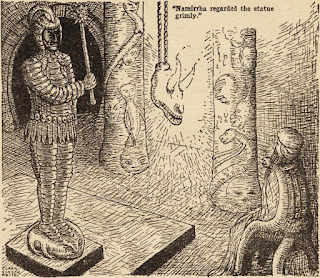
*Thasaidon featured in the short story "The Dark Eidolon" by Clark Ashton Smith, (originally published in Weird Tales in January, 1935; available to read online, here)


Illustration by Clark Ashton Smith for "The Dark Eidolon", originally published in Weird Tales (January, 1935).


Gygax envisioned a connection between Tsojcanth and Tharizdun, and incorporated Tharizdun into his "Gord the Rogue" novels.*

*see also "22 Questions on Tharizdun answered by Gary Gygax" posted on neuronphaser (June 9, 2016)


New Monsters:

WG4 "The Forgotten Temple of Tharizdun" uses monsters from the Fiend Folio (1981):

Aarakocra (Bird-Man), Caryatid Column, Coffer Corpse, Giant (Mountain Giant), Grell, Guardian Daemon, Meazel, Norker, Shadow Demon, Stunjelly

In addition, two new monsters were described:

Annis, Boggart


The WG1-4 Campaign:

If you are actually utilizing this module as an adjunct to "The Lost Caverns of Tsojcanth", you might consider what was done in the actual campaign from which both were written.  The adventurers discovered Gnome Vale in the course of seeking the 'Caverns.  Later, they returned for rest and recuperation after suffering severe damage exploring the latter place.  Only three or four of the original party actually journeyed to the 'Temple, because, as is usual with any group, some of its number were not on hand when it was time to adventure.  Because only a portion of the group went, the gnomes went along.  After initial contact and a couple of pitched battles, several of the other party members joined the three, and the 'Temple was sacked.  Losses were minimal, because the players were reasonably adept, and hit-and-run tactics were used.

Gary Gygax, from "The Forgotten Temple of Tharizdun" (1982)


Gygax ran his group through an early version of "The Village of Hommlet" back in late 1975/early 1976, and again 2-3 years later, likely as a playtest for the module.

They later adventured in a revised/expanded version of the Lost Caverns of Tsojcanth, followed by the Forgotten Temple of Tharizdun.

Gygax acknowledges the original set of players (Luke Gygax, Mike Olson, Sonny Savage, Richard Kuntz, and Mitch Preston) in WG4.*

*playtesters listed in the credits include Jeff Dolphin, Luke Gygax, David Kuntz, Richard Kuntz, Mike Olson, and Sonny Savage

See also "From Hommlet to Tharizdun, by way of Tsojcanth" posted on the Greyhawk Grognard blog (March 22, 2013).


Running WG4:

WG4 "The Forgotten Temple of Tharizdun" is designed for up to 12 characters, levels 5-10 (although ideally 4-8 characters, levels 8-10).  By comparison, S4 is for 6-8 characters, levels 6-10).

For a Master Class in running WG4, review the "Cold Text Files" (parts 1-9) accessible through the Wayback Machine, here (strange how online material regarding Tharizdun is often deleted...)

See also "Thoughts on The Forgotten Temple of Tharizdun" posted on the Greyhawk Grognard blog (April 12, 2018).

Saturday, November 13, 2021

S4: The Lost Caverns of Tsojcanth

S1 "Tomb of Horrors" and S3 "Expedition to the Barrier Peaks" were tournament scenarios (from Origins I and Origins II, respectively), precursors to the C (or "Competition") series, while S2 "White Plume Mountain" was a puzzle dungeon, submitted by Lawrence Schick.


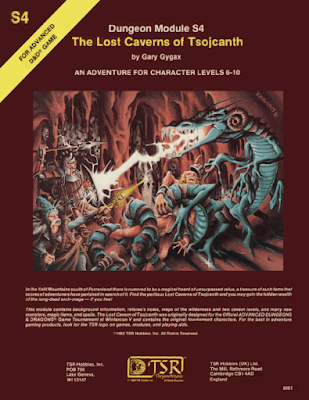
Cover to module S4 "The Lost Caverns of Tsojcanth" (1982) by Gary Gygax.  Illustration by Erol Otus.


S4 "The Lost Caverns of Tsojcanth" is similar to S1 and S3, having likewise originated as a tournament scenario (for Wintercon V in 1976), but was extensively reworked by Gary Gygax (who restocked the caverns and added a wilderness section).

The result is a heavily revised adventure, explicitly set within the recently published "World of Greyhawk" setting:

If the "World of Greyhawk" fantasy world setting is part of your campaign, the party is sponsored by the Margrave of the March of Bissel.  Perrenland, Ket, Veluna, and Iuz are enemies or rivals of Bissel.

Gary Gygax, from S4 "The Lost Caverns of Tsojcanth"


Gygax ran his Village of Hommlet group through "The Lost Caverns of Tsojcanth" (playtesters listed in the credits include Jeff Dolphin, Luke Gygax, David Kuntz, Richard Kuntz, Sonny Savage, and James M. Ward).

S4 (and its companion WG4 "The Forgotten Temple of Tharizdun") therefore serves as a fitting adjunct to T1-4 "The Temple of Elemental Evil" as part of a broader campaign set within the World of Greyhawk (perhaps concluding with the GDQ series).


The Wilderness:

Gygax states "Each hex is approximately 3.5 miles across. It shows the border areas of Ket and Perrenland, between the Velverdyva River and the town of Krestible, as shown on the map of the WORLD OF GREYHAWK Fantasy World Setting."


Approximate location of the wilderness map from S4 "The Lost Caverns of Tsojcanth" (1 hex = 3.5 miles, left) on the World of Greyhawk map (1 hex = 30 miles, right) based on terrain.


Unfortunately (and as discussed elsewhere) there is poor correspondence between the wilderness map* and World of Greyhawk map.  (See "The Southern Yatils" by Denis Tetreault for ways to address this).

*a standard scale of 8 miles/hex works much better


The Caverns:

The lesser and greater caverns represent a challenge for experienced players.  The high density of deadly creatures is problematic for some, but I like to consider this a reflection of the caverns as a nexus between worlds, so that its inhabitants constantly change.

*grodog's "The Lost Caverns of Tsojcanth" page is an excellent resource for anyone running the adventure


Booklet 2:

In addition to the 32-page scenario booklet, module S4 "The Lost Caverns of Tsojcanth" came with a 32-page supplementary booklet detailing new monsters and magical items:

New Monsters

Bat (Normal, Mobat), Behir, Bodak, Cave Cricket (Giant), Cave Moray, Cooshee,* Crystal Ooze, Dao,* Demi-Lich, Demon (Alu-Demon, Baphomet, Bar-Igura, Chasme, Dretch, Fraz-Urb-Iuu, Graz'zt, Kostchtchle, Rutterkin), Derro, Dracolisk, Elf (Valley),* Formorian, Gorgimera, Marid,* Marlgoyle, Olive Slime, Pech, Pudding (Deadly), Troll (Marine), Slime Creature, Wolfwere, Xag-Ya, Xeg-Yi

*the Dao and Marid were featured in Dragon #66 (Oct 1982), and the Valley Elf and Cooshee in Dragon #67 (Nov 1982), shortly after module S4 was released, perhaps as a form of cross-promotion

Magical Items

Potions (Rainbow Hues, Vitality)
Miscellaneous Magic (Dagger +2/Longtooth, Horn of Fog, Lens of Detection, Prison of Zagig, Slippers of Spider Climbing)

Artifacts

Daoud's Wondrous Lanthorn


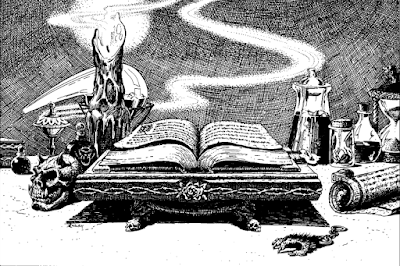
The Demonomicon of Iggwilv, illustration by Jeff Easley (with hidden messages in the script)


Demonomicon of Iggwilv:

Clerical Spells

4th Level (Abjure)
7th Level (Exaction, Henley's Digit of Disruption)

Magic-User Spells

5th Level (Dismissal, Dolor)
6th Level (Ensnarement)
7th Level (Banishment, Torment)
8th Level (Binding

Prison of Zagig


Magical Diagrams*

*appeared in earlier form as "Protection circles and the like, plus news of the north central Flanaess" in Dragon #56 (Dec 1981) in which module S4 is mentioned to be in development


Reputed Properties of Gems


Sequels and Derivative Works:

S4 "The Lost Caverns of Tsojcanth" was included in the supermodule S1-4 "Realms of Horror", with some modifications.

The loosely connected module S5 "The Dancing Hut of Baba Yaga" for 2e, by Lisa Smedman, contains additional information on Iggwilv.

The adventure was updated to 3.5e in "Iggwilv's Legacy: The Lost Caverns of Tsojcanth" (Dungeon #151, Oct 2007) by Edward Albert, Ari Marmell, and C.A. Suleiman.*

*downloadable here

See also Jason B. Thompson's walkthrough map.

Saturday, November 6, 2021

Greyhawk: The Shape of a World

I don't profess to be an expert in matters involving "The World of Greyhawk" (there are far more wizened sages on the subject).  I've only run a single campaign on Oerth (T1-4 "The Temple of Elemental Evil") and that was decades ago.


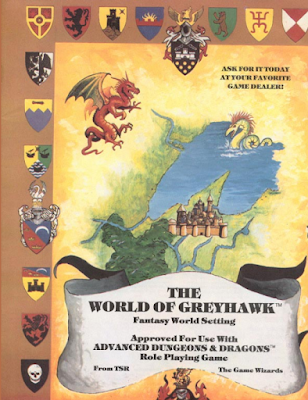
Advertisement for "The World of Greyhawk" appearing in The Dragon #39 (July, 1980) depicting the City of Greyhawk on the shores of the Nyr Dyv.


It's fascinating to read Gary Gygax's column "From the Sorcerer's Scroll" in The Dragon #37 titled "Greyhawk: The Shape of a World" discussing the soon-to-be-released "World of Greyhawk" folio, a product foretold in many of the modules preceding it.

The map of the Greyhawk Campaign came first, many years ago. The information came from a few original notes, many ideas, and the activity of the players. Just as the map was drawn from many earlier campaign maps I’d done for one game or another, so too were the states and features of the “World” drawn from many an earlier creation. When all of these odds and ends were put into play, considerable reshaping and change took place. When they were ordered and readied for formal publication, far greater mutation occurred.

Gary Gygax, from The Dragon #37 (May, 1980)


Gygax is referring to the map of The Great Kingdom, repurposed as the map of The OD&D Game World, the setting for the original Blackmoor, Greyhawk, and El Raja Key campaigns.  The beautiful map by Darlene for the World of Greyhawk folio was a new iteration.

The figure line could eventually number in the hundreds of sets, with possibly a thousand different figures. The initial release will be in the 50-set range, according to Steve. Of course, I’ll be contributing to the miniatures rules, and I’m helping to select figure types. The rules and figures will be significant contributions towards developing the “World,” but more is needed.

Gary Gygax, from The Dragon #37 (May, 1980)


It's clear that Gygax envisioned the World of Greyhawk at least partly as a setting for battles to be fought using miniatures rules.  (He even provides orders of battle for two of the original Circle of Eight (Bigby, Mordenkainen), as well as Robilar, Tenser, and Erac's Cousin).

Much of the original activity in the Greyhawk Campaign came in the huge City of Greyhawk. My initial map was only an 8½” x 11” sheet of graph paper, but this was soon enlarged to a four-times size. Even that was too small, so extra, large-scale sections were done up to supplement the main map. I have now gone to what amounts to about four-game-maps size to show the whole of the place in fair detail. The mapping isn’t complete, and only a few of the most outstanding places are noted, as there is yet many months of work left before the design will be in shape to submit to TSR’s Product Development Department. Sometime in 1981 or 1982, though, you should see a giant map and gazetteer for the City of Greyhawk being offered for sale.
Gary Gygax, from The Dragon #37 (May, 1980)


It's amazing to think that a City of Greyhawk product was actually being planned at one time (perhaps in response to Judges Guild's "City State of the Invincible Overlord" (1976).  While never published, many details were included in the Gord the Rogue novels.

While that project is yet a ways off, modules of the World of Greyhawk are currently in the works. Skip Williams is working on my original outline for Shadowland, and from what I’ve seen so far, we should be able to have a final product out this year. The module will be an adventure on the Plane of Shadow—perhaps that should be Quasi-plane of Shadow. Other such modules are also in the hopper.
Gary Gygax, from The Dragon #37 (May, 1980)


"Shadowland" never came to be, although briefly surfaced in the Summer 1986 Mail Order Hobby Shop catalog as WG7 "Shadowlords" according to The Acaeum.*  The Plane of Shadow was first described in "Deities & Demigods" (1980) as a new, inner plane.

*module code WG7 was ultimately assigned to the post-Gygax "Castle Greyhawk" (1988) compilation

As I’d mentioned in a previous column, Steve Marsh sent me a wealth of material on various planes, just as I was getting my own creative processes going. At first I envisioned a long-distance exchange with manuscripts eventually going back and forth between us. Now Steve will be coming to work for TSR this summer for a couple of months or so, and I have hope that he and I can work up general outlines and hammer out details, so that only one exchange of materials will be needed for each piece.

Because of this, there might be as many as ten World of Greyhawk modules based on the planes by the end of 1981 or mid-82.
Gary Gygax, from The Dragon #37 (May, 1980)


Gygax and Marsh did apparently collaborate on a Manual of the Planes, the manuscript for which is considered lost.  It's hard to imagine ten modules based on the planes.  (Marsh also spent much of that summer working on the D&D Expert Set Rules with David Cook.)

One whole piece of the “World” remains to be covered, and from what input I receive, it is perhaps the most important sector. It is the dungeons under Greyhawk Castle. It might seem that that would be the easiest of all to put into production. Not so!

Both Rob and I liked to “wing it” as much as possible, so as to have flexibility and to tie in past events. Think of over four dozen level maps with partial matrices, skimpy notes, cryptic symbols and areas erased or penciled over due to destructive actions! The whole 50 levels or thereabouts form a cohesive dungeon, of course, so that means to undertake the project, I must sit down and handle it all together, with as few breaks as possible, in order to reflect the general oneness. This will eventually be done, yes indeed! But I don’t dare begin at this time. . . .
Gary Gygax, from The Dragon #37 (May, 1980)


Preparing the whole of Greyhawk Castle: Expanded Version into publishable format would have been particularly daunting for Gygax, given that he would have been working from Kuntz's notes for much of it.  Perhaps the 13-level, original Greyhawk Castle would have been more realistic.*

*interestingly, Gygax and Kuntz turned to the original El Raja Key as the source for WG5 "Mordenkainen's Fantastic Adventure"

Before the dungeons of Castle Greyhawk are dusted off and construction begins anew, the rough manuscript for T2, Temple of Elemental Evil, must be finalized. With the very good words I’ve heard about the Village of Hommlet offering, I’m under considerable pressure to get T2 out—but in a form comparable to T1, so there will be much agonizing and rewriting. Then, Rob Kuntz has the reworked Lost Caverns module which must be finalized also. It was used for a MDG tournament a few years ago at WinterCon, and the scenario is very good. We want to get it into print as soon as possible.
Gary Gygax, from The Dragon #37 (May, 1980)


Here, Gygax is referring to what would have been considered WG2 "The Temple of Elemental Evil" and WG3 "The Lost Caverns of Tsojcanth" (ultimately assigned the module code S4).  WG4 "The Forgotten Temple of Tharizdun" would soon follow.

Saturday, October 30, 2021

Gen Con XIII: Against the Slavers

Gen Con XIII was held in August, 1980 on the Parkside Campus of the University of Wisconsin.  The AD&D open tournament was "Against the Slavers", a collaborative effort by David “Zeb” Cook, Harold Johnson, Tom Moldvay, Allen Hammack, and Lawrence Schick.


Gen Con XIII as advertised in The Dragon #40 (August, 1980).

According to Jake Jaquet's article "Conventions 1980" published in The Dragon #43, the tournament started with over 800 players (a sizeable proportion of the 4500 in attendance).  In a separate article, Dave Cook describes how such a large number of players was handled:

Five first rounds were required to narrow the contestants down to a mere 135 semi-finalists which in turn became only 45 finalists. To do all this required 5 different first-round scenarios, a semi-final round, and a final-round design.

Dave Cook, "Survival tips for the Slave Pits" The Dragon #43


The tournament was later published as the 4-module "Aerie of Slave Lords" series, intended for character levels 4-7.

A1 "Slave Pits of the Undercity"* combines two of the first-round scenarios (the temple and the sewers), A2 "Secret of the Slavers' Stockade" combines another two of the first-round scenarios, and the first part of A3 "Aerie of the Slave Lords" represents the fifth first-round scenario.

*in its rush to print, the map for A1 "Slave Pits of the Undercity" contained two errors:

There are two corrections to be made on the map of A1, both of which should be obvious to those DMs who have already read the module. The first is in the upper section (temple) at area 16. This should be lettered 16A, 16B, and 16C; not 16, 16A, 16B. The other is on the key to the module — a circle indicates a trap door in the floor, not a trap door in the front.

Dave Cook, "Survival tips for the Slave Pits" The Dragon #43


The second part of A3 represented the semifinal, while A4 "In the Dungeons of the Slave Lords" comprised the final round.*

*see also "The Slave Pits revisited: Suggestions for 'saving' the AD&D™ Open" by Philip Meyers, and "Mentzer’s reply: It isn’t that easy" by Frank Mentzer, in The Dragon #49


Winners of the AD&D open tournament at Gen Con XIII in August, 1980 as announced in The Dragon #43.


The A Series

The A series is notable for being set within the region of the Pomarj, the first tournament adventure designed specifically for the World of Greyhawk.

A1 "Slave Pits of the Undercity" by David Cook

Cook discusses the development of the AD&D open tournament, and A1 "Slave Pits of the Undercity" in this interview on Grogtalk (June 10, 2020) from 45:28 to 52:04

*see also Jason B. Thompson's D&D walkthrough map for A1 "Slave Pits of the Undercity"


The Temple from A1 "Slave Pits of the Undercity", original art by Jason B. Thompson


A2 "Secret of the Slavers' Stockade" by Harold Johnson and Tom Moldvay

Johnson discusses the development of the AD&D open tournament, his collaboration with Tom Moldvay on A2 "Secret of the Slavers' Stockade", and villainess Markessa in this interview on Grogtalk (January 17, 2021) from 01:12:40 to 01:24:25

A3 "Aerie of the Slave Lords" by Allen Hammack

Hammack discusses the development of the AD&D open tournament, and the final encounter in A3 "Aerie of the Slave Lords" in this interview on Grogtalk (March 2, 2020) from 59:12 to 01:03:50

A4 "In the Dungeons of the Slave Lords" by Lawrence Schick

Schick discusses A4 "In the Dungeons of the Slave Lords", and the Earth Dragon in this interview on Roll for Initiative (January 28, 2013) from 07:45 to 12:51


Sequels and Derivative Works:

The supermodule A1-4 "Scourge of the Slave Lords" (1986) was revised for character levels 7-11, to serve as a bridge between T1-4 "The Temple of Elemental Evil" and GDQ1-7 "Queen of the Spiders".

A sequel for 2e "Slavers" (2000) by Sean K. Reynolds and Chris Pramas takes place a decade after the events in A1-4 and is designed for character levels 4-5.

Hackmaster released "Smackdown the Slavers" (2002) by Brian Jelke, Steve Johansson, David S. Kenzer, Jamie LaFountain, Don Morgan, Mark Plemmons.

The 1e versions were re-released as "Against the Slave Lords"* (2013) together with A0 "Danger at Darkshelf Quarry" by Skip Williams, for character levels 1-3

*in conjunction with Dungeons & Dragons Collector's Series "The Scourge of Suderham" miniatures by Giorgio Bassani


(Left to right): Nerelas the Assassin, Mordramma the Priest, Feetla the Master Buccaneer, Ajaktsu the Magic-User and Brother Milerjoi the Monk


Also for 1e "The Last Slave Lord" in Dungeon #215 (June, 2013) serves as "A5".

Another 1e adventure "Lowdown in Highport" in Dungeon #221 (December, 2013) takes place in between A0 and A1.


Other Settings:

As a fan of the Mystara setting, I posted my thoughts on Setting modules A1-4/Slave Lords in the Gulf of Hule over at the Piazza, a while back.


Map of Hule from module X5 "The Temple of Death" with recommended location for the city of Highport from A1 "Slave Pits of the Undercity" (left) and the Gulf of Hule (right) from "Adapting classic AD&D modules to a Mystara campaign" in Threshold: the Mystara Magazine #22

Module X5 "The Temple of Death" described the land of Hule. The wilderness map included areas the DM was expected to detail further, including several unnamed towns. One of these, in southern Hule (see map) is an ideal candidate for Highport.

The population of Hule was described to be a mixture of humans and non-humans, mainly orcs, gnolls, bugbears, kobolds, and ogres. The rulers are chaotic and serve chaotic gods, and most of the human populace are either chaotic or neutral in alignment.

Placing Highport in the Gulf of Hule allows PCs adventuring in the Wild Lands to get embroiled with the Slave Lords, whose activities could be encroaching upon the civilized lands to the East, including Darokin, Karameikos, Ierendi, and Minrothad.

The proximity to Hule itself would serve well as a market for slaves from the Known World, given that slavery is likely a foundation of Hulean society. In fact, the Iron Ring in Karameikos could be allied with the Slave Lords.

Ayskudag works best in Mystara circa 1000 AC, since Highport in the Pomarj is directly north of the Drachensgrab Hills. There are even some choice nearby volcanoes for the City of Suderham.

Saturday, September 18, 2021

T1: The Village of Hommlet

T1 "The Village of Hommlet" by Gary Gygax was TSR's tenth "Dungeon Module" (not counting the special collector's edition of "Lost Tamoachan"), and was originally made available for sale at Gen Con XII in August, 1979, (along with S2 "White Plume Mountain").


Full-page advertisement for module T1 "The Village of Hommlet" appearing in The Dragon #s 31-32 (November-December, 1979)


Like module B1 "In Search of the Unknown" and S2 "White Plume Mountain", T1 "The Village of Hommlet" wasn't based on a previous tournament adventure.  Bob Byrne recounts its gaming origins in a post on Black Gate, in 2017:
 
Gygax’ son and a friend were starting to play, so Gary used the Hommlet campaign as a new, low level adventure for them, distinguishing it from the high level Greyhawk play. Gygax was busy developing TSR products and the Greyhawk Supplement (I) had come out for the Original Rules.
The Hommlet campaign was different than the Greyhawk dungeon delves. There was a village, with a smithy, an inn, a local elder, set in a rural environment. The party could role play in the village then move on to the dungeons of the Temple. It’s possible that Gygax ran players through some iterations of Hommlet and the Temple in late 1975 and into 1976.
from Black Gate* (January 6, 2017)


*Byrne's article provides a comprehensive overview of the original Temple of Elemental Evil campaign, and is well worth a read.  (There are also links to several other articles on Black Gate regarding the Village of Hommlet and Temple of Elemental Evil).

Gygax set aside his DMing responsibilities in 1976 in order to work on the AD&D rulebooks, in addition to penning the first seven dungeon modules (the G series, the D series, and S1), before turning to the ambitious World of Greyhawk folio.

Modules S1, B1, and S2 included references to the World of Greyhawk, which was originally planned for release in early 1979.  Gygax provided even more details in module T1, rendering it a perfect starting place for campaigns in the soon-to-be-published setting. 


Siege of Bodenburg:

The first Gen Con was held back in 1968, where Gygax played The Siege of Bodenburg, a medieval miniatures wargame.  He subsequently used Bodenburg Castle to represent the ruined upper works of Greyhawk Castle, as well as the floorplan of the moathouse in module T1.


Schematic for Bodenburg Castle (left) and the map for the ruined moathouse from module T1 "The Village of Hommlet" (right).

The destruction of the moathouse as recounted in "The Village of Hommlet" was apparently based on the Siege of Bodenburg, and has been recreated as a Chainmail scenario "The Battle for the Moathouse" by Paul Stormberg.


The Temple of Elemental Evil:

T1 was re-released in 1981 as a color version, with new front and back cover art, although the promised T2 "The Temple of Elemental Evil" wasn't forthcoming.

After finishing T1, Gygax was approached by Brian Blume to write a replacement module for the Holmes Basic Set, which became B2 "The Keep on the Borderlands".  (Had Blume not done so, I wonder if Gygax would have instead written T2 "The Temple of Elemental Evil"?)

Without T2, I've posted elsewhere that B2 works well as a sequel to T1.  One could even continue with WG4 "The Forgotten Temple of Tharizdun" as a Gygaxian trilogy of sorts.


The Moathouse:

The cover to D&D accessory AC5 "Player Character Record Sheets" (1984) features an illustration by Clyde Caldwell depicting a group of adventurers approaching the ruined moathouse from T1 "The Village of Hommlet".


Painting by Clyde Caldwell depicting the ruined moathouse, used for the cover of AC5 "Player Character Record Sheets" (1984)


I corresponded with Caldwell back in 2010 about this illustration, at which time he kindly responded with some additional details:

The AC5 cover painting was actually the first cover I did after coming on staff at TSR.  It was done for another module called "The Moathouse".  The publication of "The Moathouse" was delayed for some reason and the cover painting was sidelined for a while.  I don't know if "The Moathouse" module was ever published, but I think not.  The painting was picked up for AC5 since it showed a variety of generic characters.  My title for the painting is still "The Moathouse".

Clyde Caldwell, 2010


According to this interview on the Random Wizard blog, Caldwell probably began working at TSR around July, 1983.  Given that it depicts a scene from T1, "The Moathouse" may have been intended for the cover of a renumbered module WG1.*

*in Dragon #71 (March, 1983) Gygax stated "Pending work which will eventually be done includes the Temple of Elemental Evil (formerly designated as module T2 but which will be released as WG 2, part 1 and 2)"


Sequels and Derivative Works:

Gygax's original manuscript for "The Temple of Elemental Evil" was ultimately completed by Frank Mentzer and published as T1-4 "The Temple of Elemental Evil" (1985), which I ran for my friends during our senior year in high school.

A novelization of the adventure "The Temple of Elemental Evil" by Thomas M. Reid was published in 2001, as part of the "Greyhawk Classics" series.

A sequel for 3e "Return to the Temple of Elemental Evil" by Monte Cook was released in 2001, set 15 years after the original adventure.

The Temple of Elemental Evil was also developed as a video game by Atari, in 2003.

Hackmaster published "The Temple of Existential Evil" by Brian Jelke in 2003.

"Return to the Moathouse" by Mike Mearls was released at the Origins Game Fair in 2008, and a 4e conversion of "The Village of Hommlet" by Andy Collins was published in 2009, and republished in Dungeon #212 (March, 2013).

Dragon #423 (May, 2013) included a "tavern profile" on the Inn of the Welcome Wench by Shawn Merwin, and Dragon #425 (July, 2013) featured articles on the history of "The Temple of Elemental Evil" by Skip Williams, and "The Anatomy of Elemental Evil" by Thomas M. Reid.

See also Jason B. Thompson's walkthrough map.

A "Dungeons & Dragons: Temple of Elemental Evil Board Game" was released by Wizards of the Coast in 2015.

Finally, a two-volume homage and 5e conversion was just released by Goodman Games as Original Adventures Reincarnated #6 (be sure to check out the recently posted unboxing video for a sneak peak at the contents).


The Deed of Paksenarrion:

It has been pointed out that "Divided Allegiance" (1988), the second book in "The Deed of Paksenarrion" by Elizabeth Moon contains many parallels to T1 "The Village of Hommlet" (as discussed in this post from The Mule Abides blog)

Saturday, May 15, 2021

Gen Con XI: The D Series

Gen Con XI was held in August, 1978 on the Parkside Campus of the University of Wisconsin.*  Its D&D tournament was based on the D-series of A/D&D modules, which were available for purchase at the con, afterwards.

*see the UW-Parkside Library Digital Collections for archival photographs


Gen Con XI as advertised in The Dragon #s 14-17 (May-August, 1978).  The D&D tourney was based on modules D2/D3.


Gary Gygax discussed the Gen Con XI tourney in a guest editorial "MDG shows ORIGINS (and GENCON) how to run a tournament" in The Dragon #19 (October, 1978)

GenCon XI had the largest D&D tournament ever run. That same event has come in for a lot of more criticism, some justified and some not. The biggest rap against it was its sanguine nature; only one group survived RD Two. The reason behind the high mortality rate was players’ misconceptions, mostly.  Too many groups adopted the “hack and chop” mentality, and ran into far more than they bargained for. This tourney relied far more on cunning and stealth than brawn and guts. Too many groups failed to heed their directives, and paid the price.

One rap against the event does hold up; it was chaotically run, though Bob Blake did as good as can be reasonably expected of any mortal. There were scoring errors, and there were other errors as well. An article in this issue explains it better than I could.  Most of the organizational screw-ups were a result of bad communications between PAW and the tournament people, and none were fatal.

Gary Gygax, The Dragon #19


The first round of the tournament used the Shrine of the Kuo-Toa from module D2, while the second and third rounds were from module D3.

Bob Blake provided his analysis of the competition in "How Many Ettins is a Fire Giant Worth: Competitive D&D" in the same issue:

The D&D tournament at GenCon XI posed a different problem.  We used Advanced D&D Modules D2 and D3 for the scenario, and the adventurers were to follow the trail of the Drow from Module G3 through the vast system of underground labyrinths the Drow call home.  The trail led them to the Shrine of the Duo-Tao (D2), through which there was only one way to pass unscathed, and this was worth a considerable number of points. Any other approach resulted in fighting with the Kuo-Tao. If the party eventually passed through the shrine. they received points for doing so, but not as many as a “perfect” team, and additional points for slaying Kuo-Toa, the rationale being that the fish people and the party mutually disliked each other. But besides this, not much was known on the surface of this race, and any information the party could take with them regarding their strengths and weaknesses would be of value, hence points for tournament considerations. A survivor multiplier was also used, casualties being counted as those slain outright or captured and hauled away for eventual sacrifice.

Round two of the tournament shot my scoring system all to ____ (pick your favorite outer plane). Briefly, each team but one ran into a horrible encounter with a demon and died. That one team managed to survive that encounter with but one casualty and continued on, so they were declared the winners. But the difficult problem was what to do with the others; the winners had a bye in the third round, but second and third place slots were left to be filled. What had to be done was to have that DM meeting, hash over each team’s performance, then pick two teams to vie for second place. Previously in this article I mentioned the shortcomings of the subjective approach (which were my pre-formed opinions of the method), one I’ve never used in a tournament before and one I’ll never use again, if at all possible, considering how difficult it was to choose the advancing teams. I do believe we picked the two best teams, but I would have much preferred to have used some other means. A prime example of Murphy’s Law.

Bob Blake, The Dragon #19


Update (Nov 23, 2021): For more details concerning the D&D tournament at GenCon XI, see "The Deadly Illusion of GenCon 1978" over at Playing at the World (Nov 23, 2021)

The modules D1 "Descent into the Depths of the Earth", D2 "Shrine of the Kuo-Toa", and D3 "Vault of the Drow" were subsequently advertised in The Dragon #20:


Advertisement for the D series of adventures in The Dragon #20 (November, 1978).

I didn't get a chance to run the D series for my son and his friends, after they'd completed the G series (sadly, it's unlikely that we'll ever get the chance, given the prolonged hiatus).


The Drow:

The Drow were originally mentioned in the AD&D 1e Monster Manual, published the previous year:

The "Black Elves," or drow, are only legend. They purportedly dwell deep beneath the surface in a strange subterranean realm. The drow are said to be as dark as faeries are bright and as evil as the latter are good. Tales picture them as weak fighters but strong magic-users.

AD&D 1e Monster Manual (1977)


Illustration by David S. LaForce, perhaps originally intended for module D3 "Vault of the Drow", as posted on OD&D Discussion (Dec 10, 2013)


Gygax discussed potential inspirations for the race, in "Books Are Books, and Games Are Games, and Never the Twain..." from The Dragon #31 (November, 1979)

The three “D Series” modules which continue the former series owe little, if anything, to fiction. Drow are mentioned in Keightley’s THE FAIRY MYTHOLOGY, as I recall (it might have been THE SECRET COMMONWEALTH — neither book is before me, and it is not all that important anyway), and as Dark Elves of evil nature, they served as an ideal basis for the creation of a unique new mythos designed especially for AD&D.

Gary Gygax, The Dragon #31


As has been noted elsewhere, "drow" aren't specifically mentioned in either work,* and may possibly owe their origins to the svartálfar ("black elves") or dökkálfar ("dark elves") of Norse myth.

*"The Fairy Mythology" (1892) by Thomas Keightley is downloadable, here, and "The Secret Commonwealth of Elves, Fauns and Fairies" (1893) by Robert Kirk, with commentary by Andrew Lang, is downloadable, here.  Both are worth a browse.


Into the Depths:

The first two modules in the D series were re-released as D1-2 "Descent into the Depths of the Earth" (1981)* at which time D3 "Vault of the Drow" was re-issued with a new cover.  The series was included in GDQ1-7 "Queen of the Spiders" (1986).

*the D1-2 version included the Gen Con XI pregens (with names derived from "Poplollies and Bellibones: A Celebration of Lost Words" (1977), with only two re-appearing from the G series

A novelization of the series by Paul Kidd was released in 2000 as part of TSR's 25th anniversary.  The setting was the World of Greyhawk, although the original modules were generic and could be situated anywhere.


The Underdark:

The OD&D concept of the megadungeon gave way to AD&D 1e's ecosystem of the Underdark, covered in greater detail in the "Dungeoneer's Survival Guide" (1986).


Map used for the D series.  Special locations include the "Caverns and Warrens of the Troglodytes" (Q18/19) from module D1, the "Shrine of the Kuo-Toa People" (L241/42) from module D2, and the "Vault of the Drow" (Z255-57/Y254-56) from module D3.  Scale: 1 hex = 1 mile. 


The area shaded in the map above is the players' map.  The PCs begin at the bottom right, and travel to the top left.  (See this alternative players' map, from the Blog of Exalted Deeds.)

Dyson Logos created maps for additional primary, secondary, and tertiary passages (in addition to some cave geomorphs), downloadable here.

The large number of unkeyed areas have been the focus of a Dragonsfoot Collaborative Project: Mapping the Depths of the Earth, updated here.


Erelhei-Cinlu:

The article "The Vault of the Drow" by Frederick Weining, published in Dragon 298 (August, 2002) is highly regarded as an excellent resource for adding detail to the city of Erelhei-Cinlu.*

*a name derived by using the first few letters of each of the names of Gygax's first five children (Ernie, Elise, Heidi, Cindy, and Luke)

Jason B. Thompson created a D&D walkthrough map for D3 - Vault of the Drow, in addition to those for the G series (link is to WotC's web page).

Finally, I was intrigued to learn of the development of a Diplomacy variant called Drowmacy, playtested at Gary Con X in 2018.


Sequels and Derivative Works:

Update (February 9, 2022): be sure to check out D4: City of Spiders, by Joseph Block, an urban follow-up adventure to D3 Vault of the Drow, set in Erelhei-Cinlu

This Month's Most Popular Posts